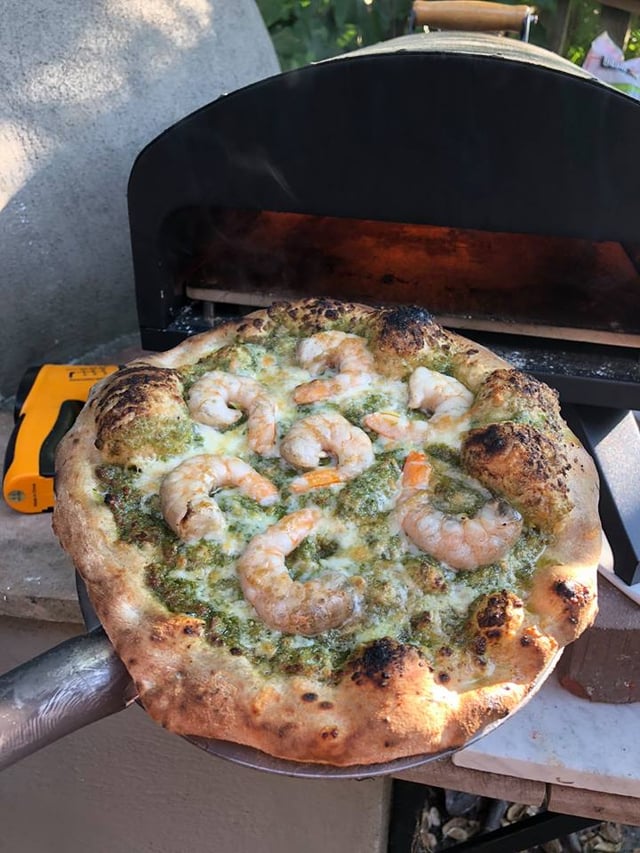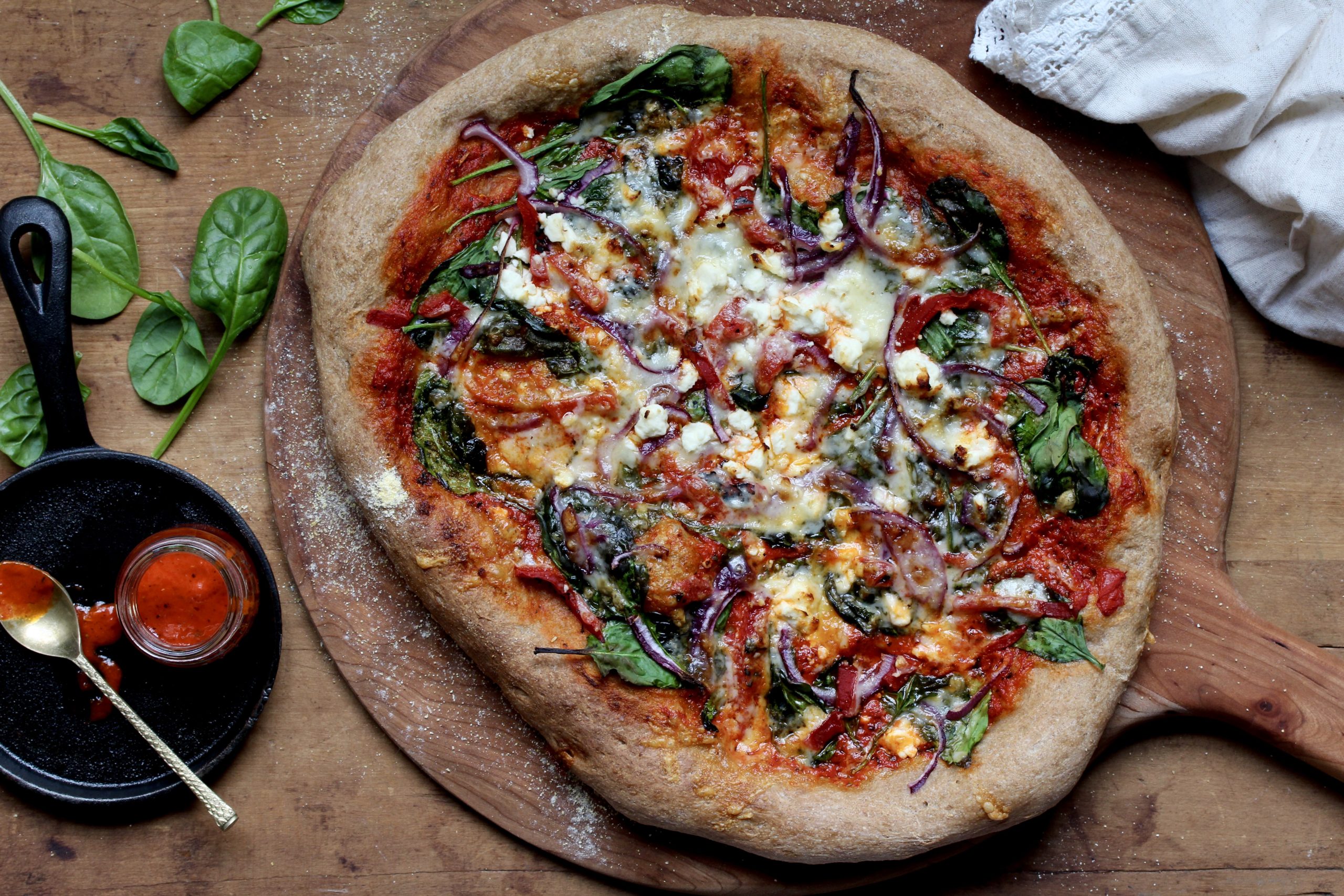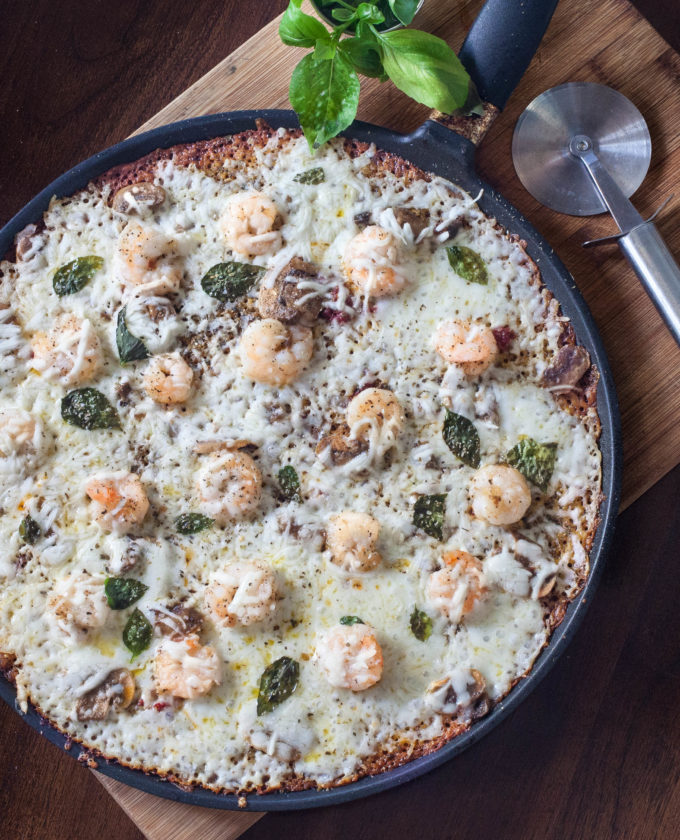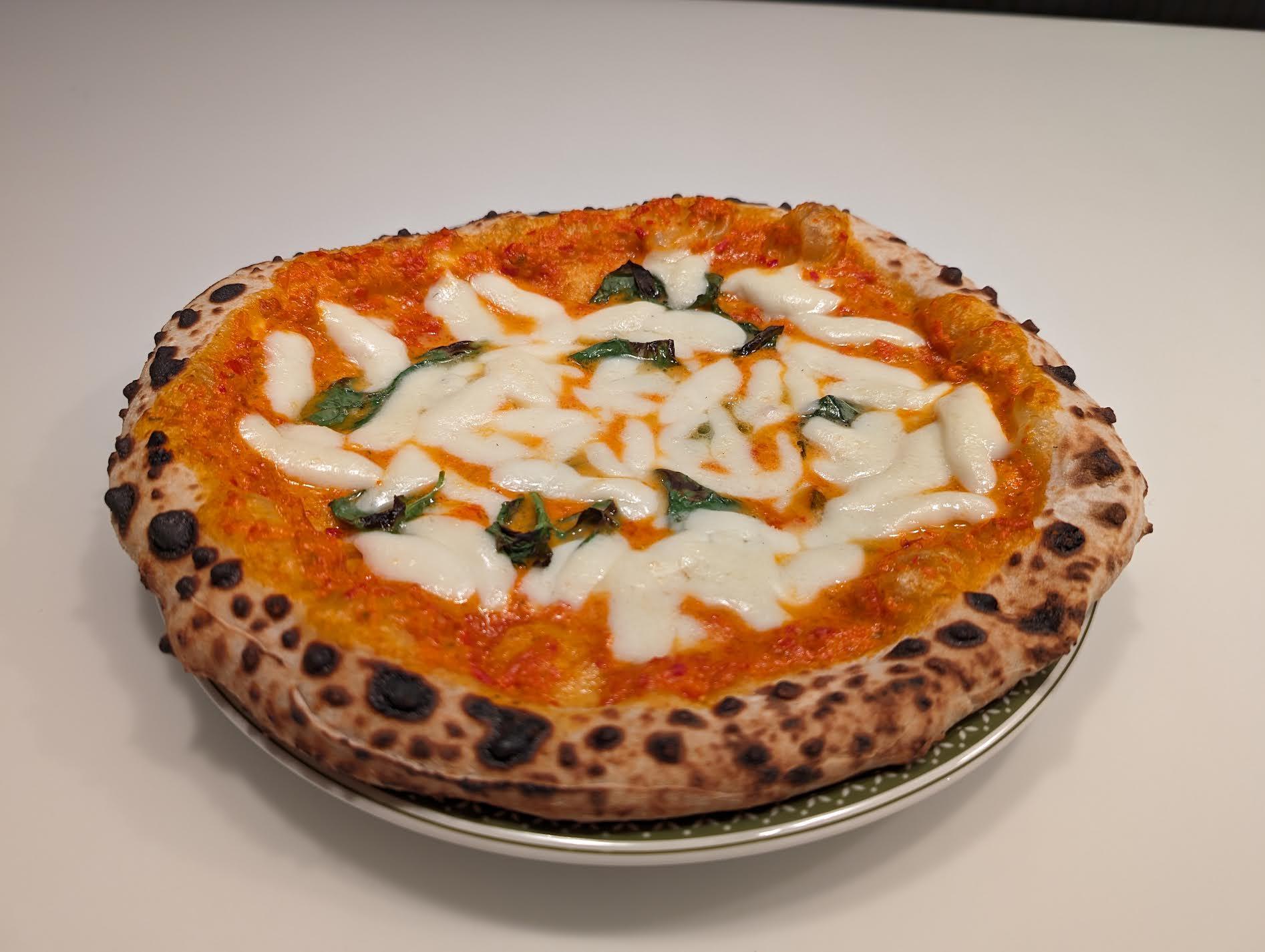
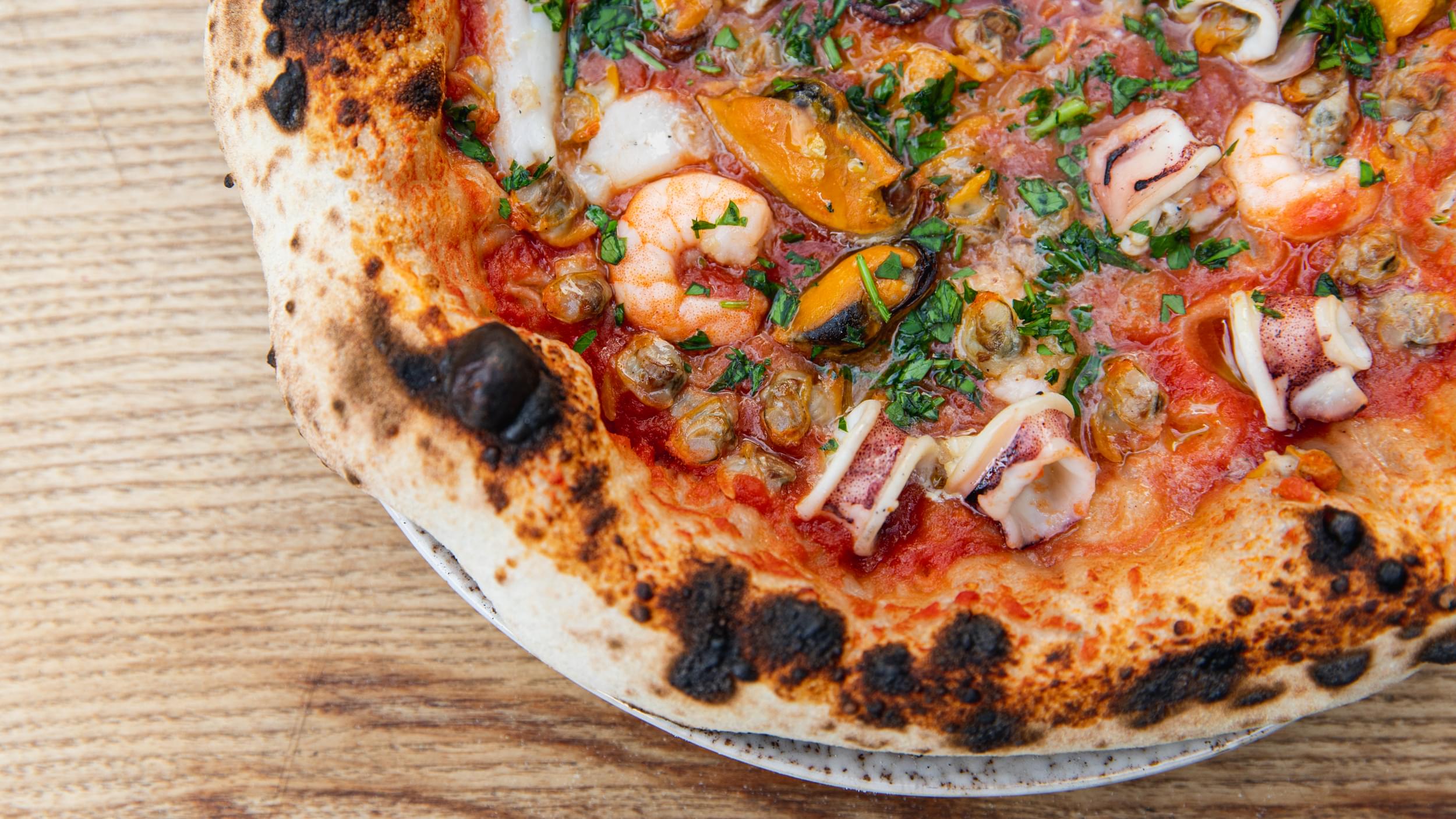
Neapolitan pizza with a leopard-spotted cornicione fresh from a wood-fired oven

Ooni 12" · 430°C · 250g balls

Ninety
Seconds.

Eleven Neapolitan combinations built from prosciutto, salmon, shrimp, mushrooms, bell peppers and mozzarella — plus a potato-and-bacon outlier and the dough recipe underneath all of them — designed around the one constraint that governs everything in a wood-fired 12-incher: the bake is over before most toppings have noticed it started.

The constraint

The oven is not the variable. Water is.

A 60-to-90-second bake at 430°C solves the crust and creates every other problem. Nothing on top has time to dry out, so any moisture you add stays — pooling under the cheese, steaming the centre flat. And nothing has time to cook, so anything that needs actual heat work has to arrive already cooked. Your six ingredients split cleanly along those two lines, which is why the combinations below all read the same way: a short list that goes IN and a shorter list that goes ON AFTER.

Dough ball
250 gPer 12" pie. Stretch to 28–30 cm, leave a 1.5 cm rim untouched.
Hydration
60 %Not 65–70. That's the home-oven number — this bake is too fast to drive off the extra water.
Flour
Tipo 00Caputo Pizzeria (red). Bread flour at 12.7% protein is the honest substitute.
Salt / yeast
2.5 / 0.15 %Baker's percentage. 0.15% yeast for a 24–48 h cold ferment; 0.3% if same-day.
Stone temp
~430 °CMeasured dead centre with an IR gun, not guessed from the flame.
Total topping
≤ 180 gEverything that goes in the oven, cheese and sauce included. Overloading is the single most common failure.
−20 minFire to full. Stone reads 430 °C centre. Flame rolling across the crown.
−2 minDress the pie on a floured bench, not on the peel. Semolina on the peel only — cornmeal scorches.
0:00Launch. Back of the stone, then pull forward slightly.
0:20 → 0:80Quarter turn every 20–30 s with a turning peel. Four turns, roughly.
0:90Out. Cornicione puffed and leopard-spotted, base dry and flexible.
+0:15Cold and cured toppings land now, on a pie that has stopped steaming. Cut and eat.

The dough

Four ingredients, forty-eight hours

Flour, water, salt, yeast. No oil, no sugar, no milk — a true Neapolitan dough has never contained any of them, and at this temperature they only burn. What makes the difference is time: the 24-to-48-hour cold ferment is doing the flavour work that a three-hour same-day dough simply cannot, and it costs you nothing but fridge space.

Baker's percentage
100 / 60 / 2.5 / 0.15Flour / water / salt / instant dry yeast. Every number below is derived from these four.
Why 60 % water
Fast bakeHigher hydration needs time to give up its moisture. In 90 seconds it can't, and you get a gummy centre under a finished crust.
Kneading
By hand10–15 min, or 8 min in a stand mixer on low. You want a smooth, tacky, extensible dough — not a tight one.
Never
A rolling pinIt crushes the gas that becomes the cornicione. Stretch by hand, always, and leave the rim alone.
Ingredient1 ball4 balls6 ballsNotes
Tipo 00 flour 154 g615 g922 g Caputo Pizzeria (red bag) is the standard. Bread flour at 12.7 % protein is the honest substitute; plain flour is not.
Water 92 g369 g553 g Cool, around 18 °C. Weigh it, don't measure by volume. In a Sydney summer kitchen go colder — fermentation runs away above 26 °C.
Fine sea salt 3.8 g15 g23 g Dissolved in the water before any flour goes in — undissolved salt tears gluten strands as you knead.
Instant dry yeast 0.23 g0.9 g1.4 g For a 24–48 h cold ferment. Double it (0.3 %) for a same-day dough. Fresh yeast: multiply by three. A 0.1 g scale earns its keep here.
Total 250 g1000 g1500 g Balls of 250 g give a 12-inch pie at roughly 3 mm in the centre. For a 16-inch oven, scale to 330 g.
  1. Dissolve. Salt into all the water, stirred until you can't feel grit. Then whisk in about 10 % of the flour to make a loose slurry, and the yeast into that — yeast never touches undiluted salt.
  2. Combine. Add the rest of the flour in three or four goes, mixing with a hand or a wooden spoon until there is no dry flour left. It will look shaggy and wrong. Cover it and walk away for 20 minutes — this autolyse does a third of your kneading for you.
  3. Knead. 10–15 minutes by hand on an unfloured bench, or 8 minutes in a mixer on low. Done is when the dough is smooth, slightly tacky, and a stretched piece goes translucent before it tears.
  4. Bulk rise. Covered, at room temperature, 2 hours. In a warm kitchen check at 90 minutes; you want it relaxed and slightly puffed, not doubled.
  5. Ball. Divide into 250 g pieces and shape each into a tight ball with a smooth, unbroken top — that skin is what holds the gas. Into a lidded container or a proofing box, spaced apart.
  6. Cold ferment. Fridge, 24 to 48 hours. 24 h is good, 36 h is better, 48 h is the edge. Past that the gluten starts to slacken and the balls spread and tear when you open them.
  7. Wake up. Out of the fridge 3–4 hours before baking — 2 hours if the kitchen is over 25 °C. The dough must reach room temperature all the way through, or the centre stays tight and won't open. A cold ball is the single most common reason a pizza comes out small and thick.
  8. Open. Flour the bench, press from the centre out with your fingertips, leaving the outer 1.5 cm untouched. Stretch over your knuckles or by draping. 28–30 cm, thin enough to see light through the middle.

Same day, 4 hours

Double the yeast to 0.3 %, bulk 2 h, ball, prove 2 h at room temperature. Bakes fine and tastes flat — this is the recipe in the Ooni manual, and it's the reason people conclude their oven is the problem.

Overnight

Mix in the evening, ball, straight to the fridge, out in the morning, bake at dinner. Roughly 18 hours. The best return on the least planning.

Poolish, 22 hours

An 18 h preferment of equal flour and water plus a pinch of yeast, then build the final dough around it and prove 4 h. Deepest flavour available, most fuss, and worth doing once to know what you're chasing.

It tore when I opened it

Over-fermented, or the ball was over-tightened at shaping and the skin gave. Also check the fridge time — past 48 h at 60 % hydration the structure goes.

It won't stretch, it springs back

Under-rested. Either the ball is still cold in the middle or it hasn't had its 3 hours out. Give it another 30 minutes rather than fighting it.

No leopard spots

Almost always the stone rather than the dough — under 400 °C you get an even tan instead of spotting. Let the flame roll across the crown for another 10 minutes and check the centre with an IR gun.

The larder

What each ingredient wants

Get this table right and the combinations almost design themselves. Get it wrong and it doesn't matter which combination you picked. The six you asked for, plus the three that carry the potato pie at the end.

IngredientTimingPrep before it goes anywhere near the piePer 12"
Prosciutto crudoON AFTER Nothing. Raw cured ham in a 430°C oven turns to salted leather and its fat renders away — the whole point is the silk. Drape it on the hot pie so it slackens and gleams. Parma is the default; San Daniele (sweeter, longer-aged) and speck (lightly smoked) substitute directly. Take it out of the fridge 20 minutes ahead — cold crudo is waxy. 3 slices · ~25 g
Prosciutto cottoIN The opposite ingredient, and the exception to the ham rule: cooked ham wants the oven. Torn into rough pieces rather than laid in flat discs, so the edges lift and catch colour. Mild and faintly sweet, so it needs salt from elsewhere — pecorino, capers, or an olive. Cotto plus mushroom plus tomato is the Neapolitan capricciosa family, and it is the one build here where ham and heat belong together. 50 g
Smoked salmonON AFTER Nothing, and don't let it touch heat. Cold-smoked salmon cooked is just sad hot fish. Tear rather than lay flat, so it catches light. 40–50 g
Fresh salmonIN late Skinless, 1.5 cm dice, patted dry, salted 10 min ahead and blotted again. Add at the 30-second mark through the oven mouth — a full 90 s overcooks it. 70 g
ShrimpIN Peeled, deveined, butterflied down the back so they lie flat and thin — that's what lets them cook in 90 s. Salt 10 min, then pat bone dry. Anything bigger than a large prawn: sear it in a cast-iron pan in the oven first and add it in the last 20 s instead. 5–6 · ~70 g
MushroomsIN Always pre-cooked, no exceptions. Dry-sauté hard in a wide pan until they squeak, release their water, and that water fully evaporates — then oil, garlic, thyme, salt. Raw mushrooms on a 90-second pie flood it. 60 g raw → 35 g cooked
Bell peppersIN Two valid routes. Roasted and peeled, torn into strips — sweet, jammy, low-water. Or sliced raw at 2 mm on a mandoline — sharp, grassy, keeps a bite. Never thick raw chunks: they stay squeaky and weep. 40 g
Fior di latteIN Torn by hand into 2 cm pieces, drained in a colander 30 min (or overnight in the fridge), then blotted. Tearing beats slicing — irregular edges melt at different rates and give you pools instead of a lid. 70–80 g
San MarzanoIN Crushed by hand, salted, raw. No cooking, no herbs, no sugar, no simmering it down — it cooks on the pie. If it's watery, drain the tin through a sieve first and keep the pulp. 70 g
PotatoIN Waxy, not floury — Desiree, Nicola, a red-skin. Mandoline at 1.5–2 mm, rinsed to shed surface starch, then simmered 3 minutes in well-salted water and cooled flat on a towel. Raw slices will not cook in 90 seconds; they come out chalky. Toss the cooked slices in olive oil, salt and rosemary before they go on. 90 g raw
Pancetta / baconIN Cut into 1 cm lardons and rendered in a dry pan only until the fat starts to run and turns translucent — not crisp. It finishes in the oven, and fully crisped bacon going in comes out burnt. Keep a spoonful of the rendered fat and brush it on the dough in place of oil. 40 g
Truffle oilON AFTER Nothing — and never in the oven. The aroma compounds are volatile; at 430 °C they are gone before the pie is, leaving only the oil. Three or four drops from a teaspoon on the finished pizza, never a drizzle. Almost all supermarket truffle oil is synthetic 2,4-dithiapentane rather than truffle, which is exactly why restraint reads as luxury and excess reads as a petrol station. 3–4 drops

Raw cured meat and cold-smoked fish are not toppings. They are garnishes that happen to be the reason you made the pizza.

Two foundations

Rossa or bianca

The choice isn't aesthetic. Tomato brings acid and water; a white base brings fat and salt. Match it to what you're putting on top — acid fights delicate seafood and buries cured ham, fat carries both.

Rossa

70 g hand-crushed San Marzano, salt, a thread of olive oil. Spread in a spiral with the back of a ladle, stopping 1.5 cm from the edge.

  • Goes with: shrimp, mushrooms, roasted peppers, chilli, garlic, oregano.
  • Fights: smoked salmon (acid + smoke is a losing pair), and it flattens prosciutto crudo unless the ham lands after the bake — though it suits prosciutto cotto, which goes in before it.
  • Watch: tomato is the biggest single water load on the pie. Under-sauce rather than over-sauce.

Bianca

Three versions, in ascending richness: olio e mozzarella (garlic oil brushed on the dough, torn fior di latte, black pepper) · ricotta base (80 g ricotta loosened with olive oil and lemon zest, dotted not spread) · crème fraîche (added after the bake, never before — it splits).

  • Goes with: prosciutto crudo, salmon in both forms, mushrooms, thyme, lemon, rocket, parmesan.
  • Fights: nothing much — which is the trap. A bianca with five things on it is just a rich mess.
  • Watch: without tomato's acid you must add brightness yourself — lemon zest, black pepper, or a peppery leaf.

Four with tomato

Rossa

Wood-fired seafood pizza with prawns
Rossa

Gamberi e Peperoni

Shrimp, roasted red pepper, garlic-chilli oil

  • 70 gSan Marzano, hand-crushed, salted
  • 50 gFior di latte — deliberately light, it's competing with the shrimp
  • 6Butterflied shrimp, laid flat, cut side down
  • 40 gRoasted red pepper, torn into strips
  • 1 tspGarlic-chilli oil, drizzled
On afterFlat-leaf parsley, torn. A squeeze of lemon. Nothing else.

The one combination where the shrimp genuinely cooks in the bake — butterflied, they're 5 mm thick. Roasted pepper does the work of a sauce reduction without the water. Keep the cheese down: this is a seafood pie, not a cheese pie wearing shrimp.
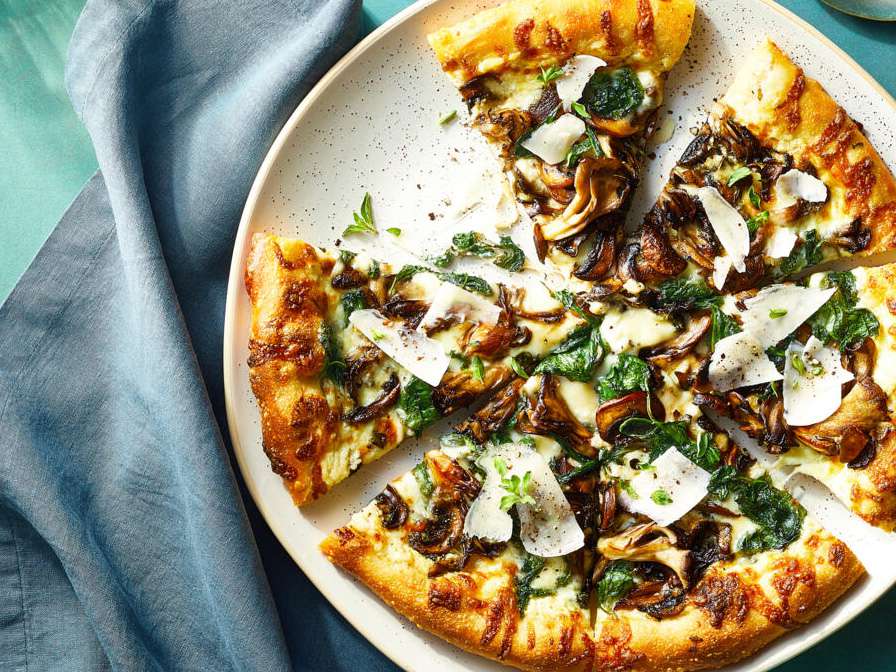
Mushroom pizza with herbs
Rossa

Boscaiola

Mushrooms, oregano, pecorino

  • 70 gSan Marzano
  • 70 gFior di latte, torn and drained
  • 35 gMushrooms, dry-sautéed dry with garlic and thyme
  • pinchDried oregano — rubbed between the palms first
On afterGrated pecorino romano and a hard grind of black pepper, so the cheese stays sharp instead of melting into the background.

The plainest pie here and the best diagnostic: if this one comes out soggy, your mushrooms weren't dry enough. Mixed mushrooms beat button — chestnut for body, a few oyster or shiitake for the edges that crisp and go almost meaty.

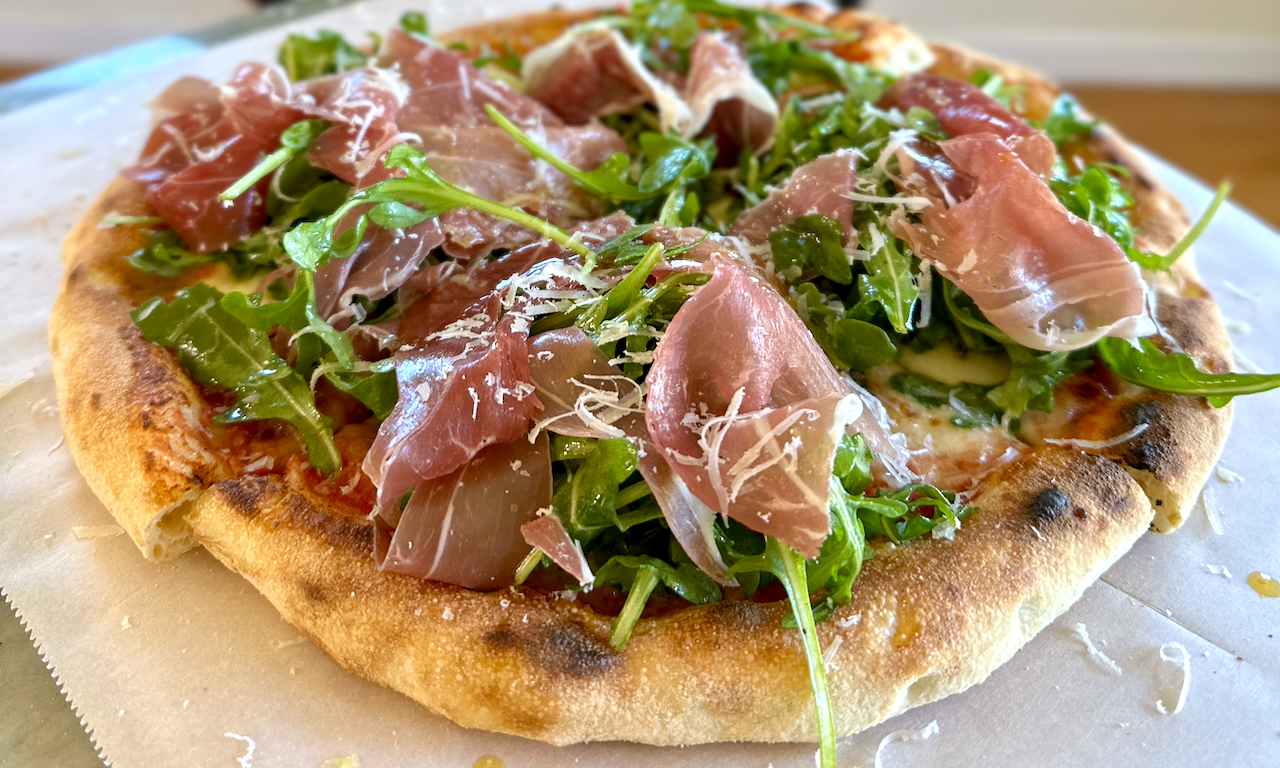
Pizza finished with prosciutto and rocket
Rossa

Peperoni Gialli e Prosciutto

Yellow pepper, fior di latte, prosciutto crudo after

  • 60 gSan Marzano — under-sauced on purpose
  • 80 gFior di latte
  • 40 gRoasted yellow pepper, torn (sweeter and less acidic than red)
  • Basil leaves, tucked under the cheese so they steam rather than burn
On after3 slices of prosciutto crudo, draped in loose folds while the pie is still radiating. A thread of good olive oil.

Yellow pepper's sweetness is the bridge between tomato acid and cured salt — red pepper is good here, yellow is better. Draping matters: folds catch heat and release the fat's aroma; flat slices just sit there. Cotto variant: swap in 50 g of torn prosciutto cotto and it goes on before the bake instead, under the cheese — a rounder, more domestic pizza, and a much better one for anyone who finds crudo too salty.

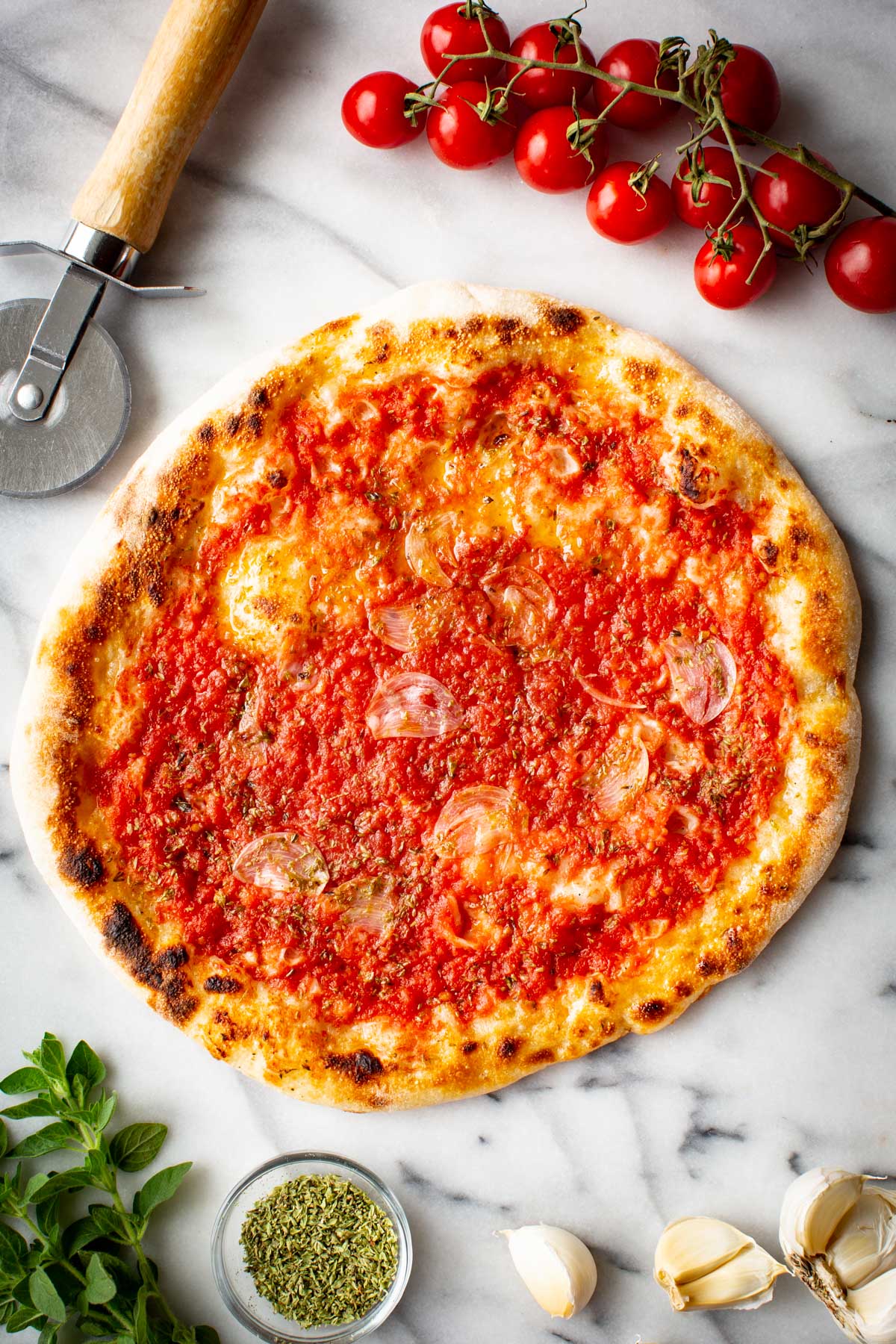
Cheeseless Neapolitan pizza marinara
Rossa

Marinara di Mare

No cheese. Shrimp, garlic, oregano, lemon

  • 80 gSan Marzano — more, since it's carrying the pie alone
  • 2Garlic cloves, sliced paper-thin
  • 6Butterflied shrimp
  • goodDried oregano, olive oil, sea salt
On afterLemon zest, a little juice, parsley.

The Neapolitan-orthodox seafood answer — in Naples, cheese and fish don't share a pie, and once you've tasted this you'll see the argument. Without mozzarella the crust and the tomato both get louder, and the shrimp taste like shrimp rather than like cheese. Make this one first, before the pizza gets complicated.

Seven without

Bianca

This is where your ingredient list actually lives. Prosciutto, both salmons, mushrooms and shrimp are all happier without tomato underneath them.

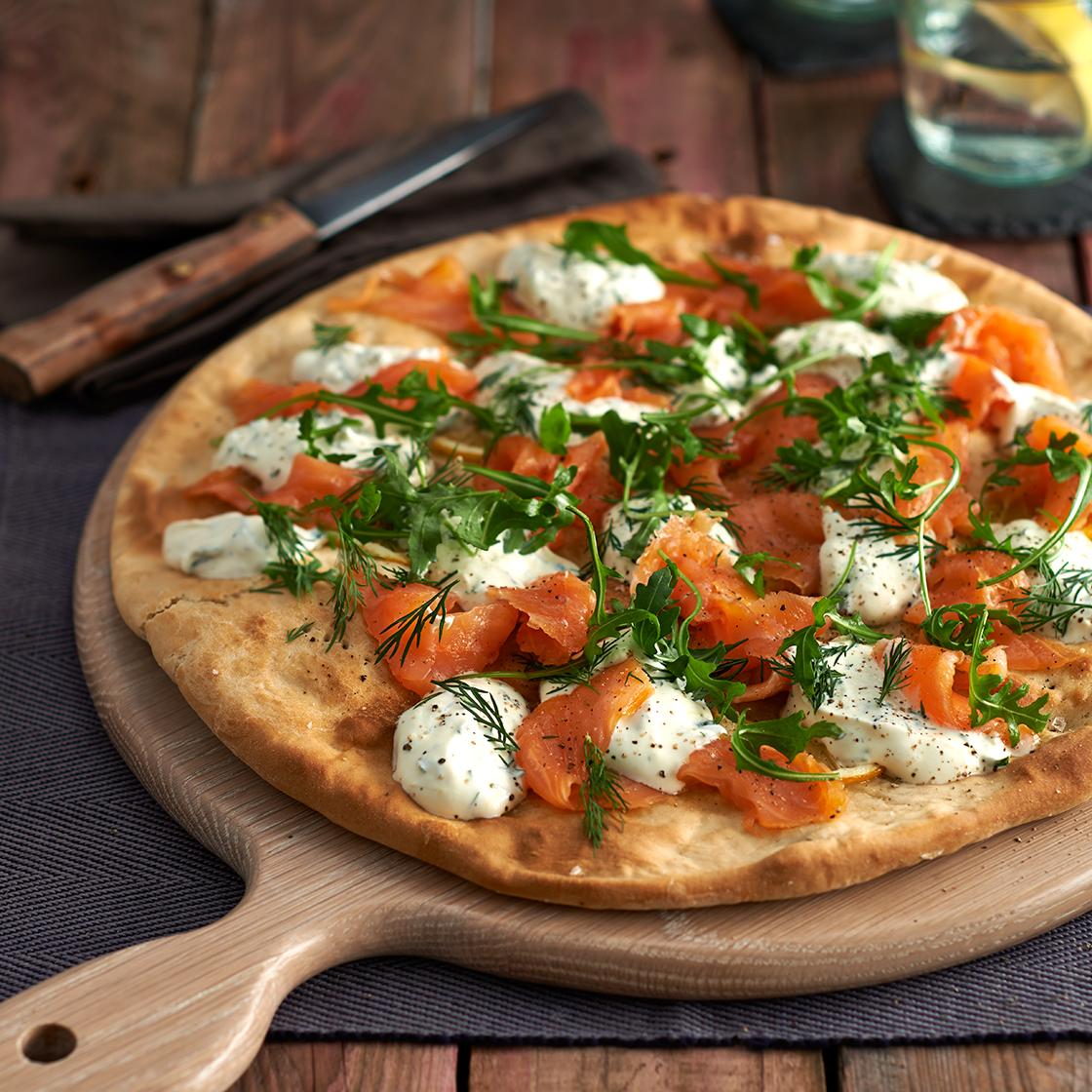
Smoked salmon pizza with crème fraîche and dill
Bianca

Salmone e Limone

Smoked salmon, lemon crème fraîche, dill

  • 1 tspOlive oil brushed over the dough
  • 70 gFior di latte, torn and well drained
  • grindBlack pepper. That's the entire oven build.
On after50 g cold-smoked salmon, torn into ribbons · dots of crème fraîche whipped with lemon zest and juice · dill fronds · capers if you like them · more pepper.

The best pie on this page, and barely a recipe — a plain cheese pizza used as a hot plate for cold fish. Everything cold goes on after the pie stops steaming, or the crème fraîche breaks and the salmon goes opaque and greasy. Wait fifteen seconds. It matters.

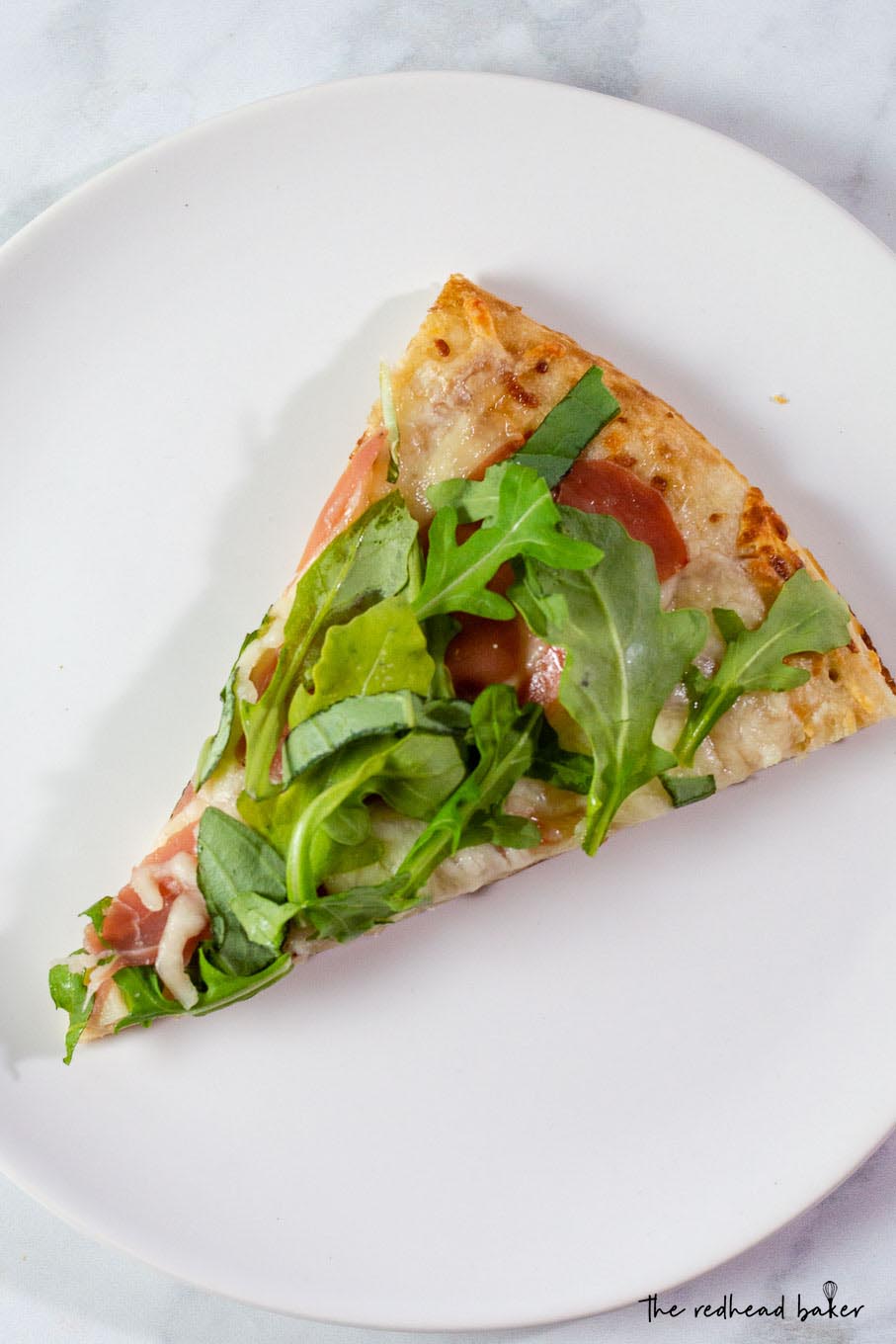
White pizza with prosciutto and rocket
Bianca

Prosciutto, Rucola, Parmigiano

The canonical bianca. Three things, no tomato

  • 1 tspGarlic-infused olive oil, brushed
  • 90 gFior di latte — generous here, it's the base and the sauce
  • grindBlack pepper
On after3–4 slices prosciutto crudo · a handful of rocket dressed in lemon and oil in a separate bowl · shaved parmigiano · olive oil.

Dress the rocket before it touches the pizza, never on top — oil and lemon poured over a hot pie run straight into the crust and make it soggy in about four seconds. The lemon in the dressing is doing the job tomato acid would otherwise do.

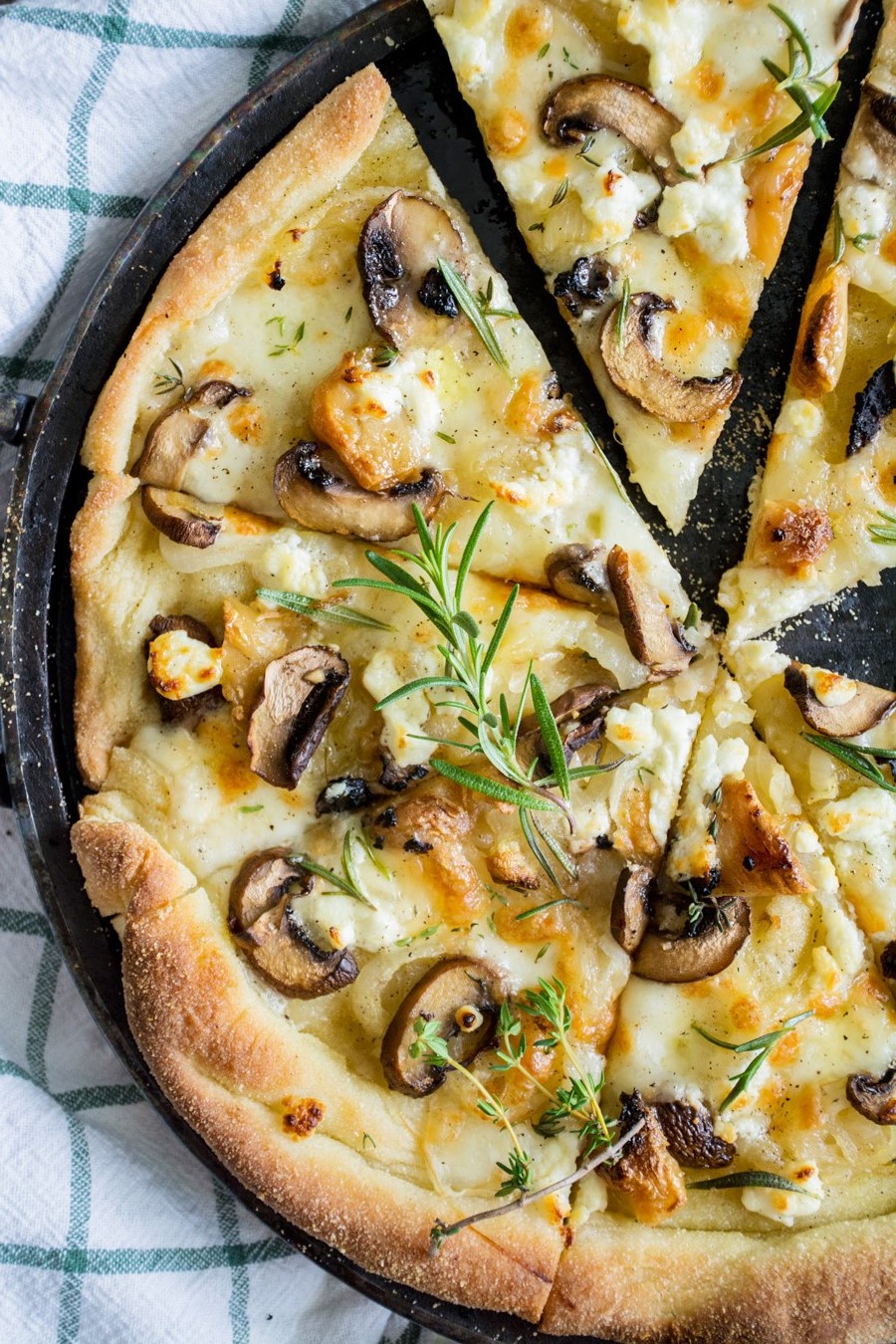
Mushroom pizza bianco with truffle oil and fresh herbs
Bianca

Funghi al Timo

Mushrooms, thyme, garlic, a whisper of truffle

  • 1 tspGarlic oil
  • 75 gFior di latte
  • 45 gMixed mushrooms, dry-sautéed with thyme until browned and completely dry
  • 15 gGrated parmigiano, under the mushrooms
On afterFresh thyme leaves. Two or three drops of truffle oil — drops, not a drizzle. Flaky salt.

Without tomato you can taste the mushrooms properly, which is the point. The parmigiano underneath melts into a savoury floor that stops the mushrooms sitting on the pie like a garnish. Truffle oil is easy to overdo and unforgivable when you do.

Shrimp pizza baked in a wood-fired oven
Bianca

Gamberi al Bianco

Shrimp, lemon, chilli, basil

  • 1 tspChilli-garlic oil
  • 60 gFior di latte, scattered not blanketed
  • 6Butterflied shrimp, bone dry
  • Thin slivers of fresh red chilli
On afterLemon zest, a hard squeeze of juice, basil torn at the last second, olive oil.

Fat instead of acid under the shrimp, so the sweetness comes through — this is the same ingredient as the Gamberi e Peperoni and it tastes like a different animal. The lemon after the bake is doing the tomato's job from above, where you can control it.

Roasted red pepper pizza with rocket
Bianca

Tre Peperoni e Ricotta

Ricotta base, three roasted peppers, prosciutto after

  • 80 gRicotta loosened with olive oil, lemon zest and salt — dotted, not spread
  • 50 gFior di latte, in the gaps between the ricotta
  • 50 gRoasted red, yellow and green pepper, peeled and torn
On after3 slices prosciutto crudo · basil · black pepper · olive oil.

Dotting rather than spreading the ricotta is the whole technique: you get pockets of cool, milky cheese against blistered pepper instead of a uniform pale layer. Green pepper is the bitter note that stops three peppers tasting like jam.

Pizza with shrimp and mushrooms
Bianca

Mare e Monti

Mushrooms and shrimp — the greedy one

  • 1 tspGarlic oil
  • 60 gFior di latte
  • 30 gMushrooms, dry-sautéed, scattered on one half-ish
  • 5Butterflied shrimp on the rest
On afterParsley, lemon zest, olive oil.

Sea and mountain, the Italian pairing that shouldn't work and does. Keep the two ingredients in loose zones rather than mixed — you want bites of each, not a stew. This is also the pie where the topping ceiling bites hardest: 90 g of solids plus 60 g of cheese is already at the limit.

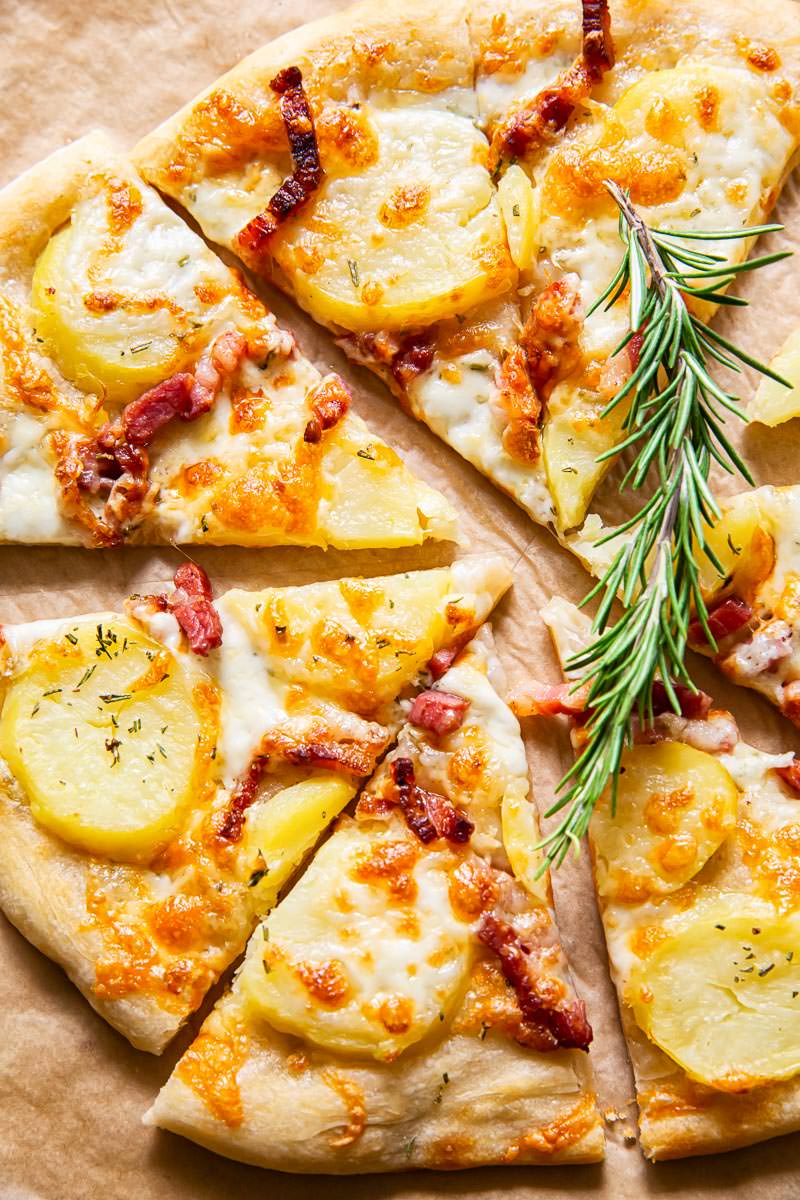
White pizza with thinly sliced potato and pancetta
Bianca

Patate, Pancetta e Tartufo

Potato, bacon, rosemary, truffle oil

  • 1 tspRendered bacon fat, brushed over the dough instead of oil
  • 60 gFior di latte — restrained; the potato is already the starch and the sauce
  • 90 gPotato, sliced 1.5–2 mm, par-boiled 3 min, dried, tossed with oil, salt and rosemary — laid overlapping like roof tiles
  • 40 gPancetta or streaky bacon in 1 cm lardons, part-rendered but still soft
  • Rosemary needles, chopped fine. Go easy: it turns medicinal fast.
On after3–4 drops of truffle oil · grated parmigiano · flaky salt · a hard grind of black pepper. A few rocket leaves if you want something green to cut it.

Starch on starch, which sounds like a mistake and is a Roman and Ligurian classic — the potato behaves like a sauce, going creamy underneath and crisping at the tile edges where it meets the flame. Everything here is about part-cooking: raw potato stays chalky in 90 seconds, and bacon taken to crisp in the pan comes out of the oven burnt. Both want to arrive most of the way there. And the truffle oil goes on at the end, in drops, because heat destroys the aroma and leaves you with nothing but oil.

Failure modes

Five ways this goes wrong

The soggy centre

Too much sauce, undrained cheese, or raw mushrooms. Almost never the oven. Weigh your toppings once — 180 g total is less than it looks — and you'll stop guessing.

Leathery ham

Prosciutto crudo went in the oven. Crudo cannot go in the oven. If you want cured pork baked onto a pie, that is what prosciutto cotto is for — or speck, or pancetta.

Rubbery shrimp

Whole prawns left in for the full 90 s, or pre-cooked shrimp cooked twice. Butterfly small ones and add raw; sear big ones in a pan and add them in the last 20 seconds.

Split crème fraîche

It went on before the bake, or onto a pie that was still steaming. Dairy that isn't mozzarella belongs on the finished pizza after a fifteen-second pause.

Burnt basil, burnt garlic

At 430 °C both go black in seconds. Tuck basil under the cheese or add it after; use garlic as an infused oil, or slice it paper-thin and bury it in the sauce.

Pale, floppy base

Stone not actually at temperature, or the pie sat on it after the flame died back. Check the centre of the stone with an IR gun and let the flame keep rolling across the crown between pies.

One evening

A running order that works

Six balls of dough, four people, roughly forty minutes of baking. Order matters — you're managing both palates and prep.

  1. Prep the day before. Dough mixed and balled, in the fridge 24–48 h. Mushrooms sautéed and cooled. Peppers roasted, peeled, torn. All of it keeps.
  2. Two hours out. Dough balls to room temperature. Tear and drain the fior di latte. Butterfly and salt the shrimp, then blot them and keep them cold.
  3. Fire up 20 minutes before the first pie. Bake one plain margherita as a calibration pie. It tells you the stone temperature and the turn rhythm before it matters.
  4. Marinara di Mare first, while palates are clean and nobody's had cheese yet. The cheeseless one always disappears fastest, which surprises people every time.
  5. Gamberi e Peperoni, then Boscaiola — the two tomato pies, back to back while the stone is at its hottest.
  6. Funghi al Timo and Prosciutto, Rucola, Parmigiano as the middle of the evening. Switch to the bianca builds and the whole meal changes register.
  7. Patate, Pancetta e Tartufo when the fire has had an hour of pies through it and people have stopped pretending they aren't full. It is the richest thing on this page and it wants to arrive late.
  8. Salmone e Limone last, on purpose. It's cold, sharp and clean, it needs no oven work beyond a plain cheese pie, and it functions as dessert's opposite — the thing that resets your mouth after an hour of fire.